Last updated: 15 Oct 2026, 7:38 AM IST. Added what we're hearing from our payment-collection clients and a new FAQ on personal QR codes. NPCI's announcement of 13 October 2026 (NPCI press release) still stands, and the exact start date hasn't been notified yet. We'll update this post again when it is.
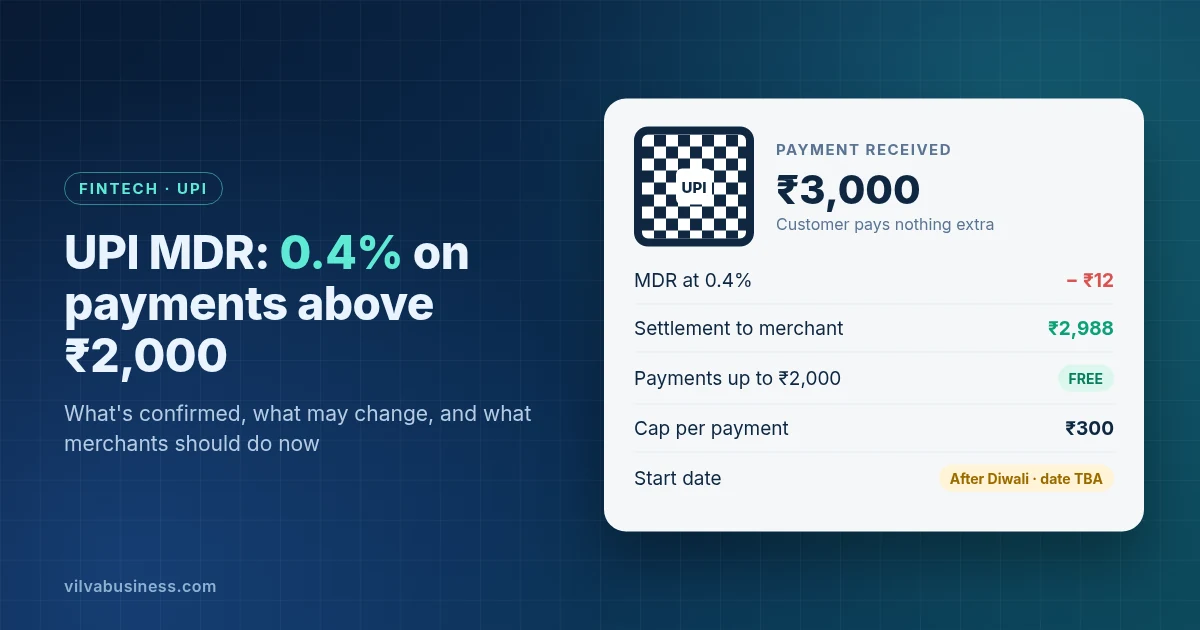
Short answer: UPI MDR is a 0.4% fee on merchant payments above ₹2,000, capped at ₹300, with payments up to ₹2,000 and person-to-person transfers staying free. On 13 October 2026, NPCI announced that it will not start on 15 October 2026: it will be implemented "immediately post Diwali at a date to be notified separately" (NPCI press release). NPCI's release changes only the timing, so the published rates and exemptions still stand unless NPCI says otherwise.
What's official (as of 13 Oct 2026, 5:17 PM IST)
- Start date: immediately after Diwali, exact date to be notified. On 13 October 2026, NPCI announced that the UPI and Services Steering Committee "decided that, keeping in mind the festive season, Merchant Discount Rate (MDR) on select Person-to-Merchant (P2M) UPI transactions, shall be implemented immediately post Diwali at a date to be notified separately" (NPCI press release, 13 Oct 2026). This replaces the 15 October 2026 date in the government's FAQ of 15 September (Govt FAQ, Q5). Diwali falls on 8 November 2026.
- 0.4% MDR on person-to-merchant (P2M) UPI payments above ₹2,000, capped at ₹300 for payments of ₹75,000 and above (PIB, 15 Sep 2026).
- Free: P2P transfers of any amount, merchant payments up to ₹2,000, and small P2PM merchants receiving up to ₹1 lakh a month through UPI QR (PIB).
- Flat ₹5 for specified essential sectors; 0.02% (max ₹300) for capital-market payments (PIB).
- No pass-through: merchants must not pass MDR on to customers (Govt FAQ, Q34).
- UPI AutoPay (recurring mandates) carries no prescribed MDR (Govt FAQ, Q22).
What's still undecided
- The exact start date. NPCI has said only "immediately post Diwali", with the date "to be notified separately" (NPCI, 13 Oct).
- Whether the small-merchant exemption widens to businesses with up to ₹40 lakh annual turnover (from ₹1 lakh a month today). This was reported as under consideration (Business Standard, 8 Oct).
- How some categories will be classified, such as manual loan repayments and broker top-ups (Moneycontrol, 8 Oct).
- How much of the MDR your payment gateway or aggregator passes on to you (Financial Express, 8 Oct).
What is UPI MDR, and who actually pays it?
MDR (merchant discount rate) is the fee a business pays to the bank and payment companies that process a digital payment. On 15 September 2026, the Press Information Bureau announced that UPI would move away from zero MDR for a limited set of merchant payments, under the Payment and Settlement Systems Act, 2007.
Three points matter for you as a business owner:
- The merchant pays, not the customer. The PIB release says MDR "is not a charge on customers making UPI payments", and banks have been told to make sure merchants don't pass it on.
- It isn't a tax. PIB says MDR is "neither a tax nor a charge collected by the Government or NPCI". It's shared among banks, payment service providers and UPI apps.
- Most payments aren't affected. The government says MDR will apply to only about 4% of merchant transactions; the other 96% are either ₹2,000 or less or come from small merchants under the zero-MDR framework (PIB).
The rates and caps are set by the UPI and Services Steering Committee, which is headed by NPCI (Govt FAQ, Q7).
How much will a UPI payment cost my business?
For a regular business (P2M) account, the maths is simple: 0.4% of the payment if it's above ₹2,000, and never more than ₹300. The government's own FAQ works through ₹3,000 (₹12), ₹50,000 (₹200) and ₹1,00,000 (₹300) (Govt FAQ, Q35). Here's how it works out on common bill sizes:
| Customer pays (UPI) | Rule that applies | MDR you pay |
|---|---|---|
| ₹1,500 | ₹2,000 or less: free | ₹0 |
| ₹2,000 | ₹2,000 or less: free | ₹0 |
| ₹3,000 | 0.4% | ₹12 |
| ₹10,000 | 0.4% | ₹40 |
| ₹50,000 | 0.4% | ₹200 |
| ₹75,000 | Cap applies | ₹300 |
| ₹1,00,000 | Cap applies (0.4% would be ₹400) | ₹300 |
| ₹10,000 to a small P2PM merchant | Zero-MDR category | ₹0 |
| ₹4,000 insurance premium | Flat-fee sector | ₹5 |
Figures are the framework rates as published on 15 Sep 2026. NPCI's 13 Oct 2026 announcement moved only the start date. Your bank or gateway's actual deduction may differ, so check with your provider.
So a Coimbatore electronics shop that takes 200 UPI payments of ₹10,000 a month would pay about ₹8,000 a month in MDR (200 × ₹40), while a Chennai tea stall where every bill is under ₹2,000 would pay nothing. Selling online this festive season? See our Diwali 2026 online sales playbook.
Which UPI payments stay free?
According to the PIB release and the government FAQ (both 15 Sep 2026):
- Person-to-person transfers, of any amount, including self-transfers.
- Merchant payments of ₹2,000 or less.
- Small merchants in the P2PM category. These are vendors who receive up to ₹1 lakh a month through a UPI QR code straight into their own account. They pay zero MDR even on a single payment above ₹2,000. GST registration isn't needed to qualify.
- What moves you out of P2PM: if your inward UPI credits go above ₹1 lakh a month for three months in a row, your bank moves you to the regular P2M category (Govt FAQ, Q29).
- UPI AutoPay payments. Recurring mandates (bills, subscriptions, SIPs) "do not carry prescribed MDR transaction charges" (Govt FAQ, Q22).
- Your existing QR code keeps working. You don't need a new QR or soundbox (Govt FAQ, Q25).
Which businesses pay a flat ₹5 or a lower rate?
The PIB release lists two special cases:
- Flat ₹5 per payment above ₹2,000 in "essential and thin-margin sectors, including railways, telecommunications, insurance, fuel and agricultural inputs". The government FAQ also puts utility bill payments (electricity, water, piped gas) in the ₹5 group (Q41).
- 0.02%, capped at ₹300, for payments to mutual funds, securities, stockbrokers and dealers.
For schools and colleges, the FAQ says fee payments above ₹2,000 get "flat-fee structures or capped processing rates" but doesn't publish the exact figure (Q42). Business Standard reported on 8 Oct that education would get the ₹5 flat fee (source). If you run an institution, confirm your category with your acquiring bank.
When does UPI MDR start?
Immediately after Diwali, on a date NPCI will notify separately (NPCI, 13 Oct 2026). It does not start on 15 October 2026, the date in the government's original FAQ. Here's what happened, in order:
- 8 Oct: Business Standard reported that a deferral to 1 January 2027 was "under consideration" (source). Moneycontrol reported that merchant bodies, fintechs and payment companies had asked NPCI for the delay (source). At 6:02 PM IST, Finance Minister Nirmala Sitharaman said any deferment "will be handled by the stakeholders" (Moneycontrol).
- 9 Oct: the UPI Steering Committee meeting on MDR, expected to decide the date, "did not take place", according to two sources who spoke to Moneycontrol. There was "no clarity on when the meeting will take place" (Moneycontrol, 7:12 PM IST).
- 10 Oct: Free Press Journal reported that NPCI had not announced a revised meeting date or confirmed whether 15 October would proceed, and that several industry executives reportedly supported keeping 15 October (Free Press Journal, 5:01 PM IST).
- Reuters' report: a deferral to 1 January 2027 was likely, according to a regulatory official and an industry executive (as reported by BFSI Updates). NPCI's eventual decision was earlier than that.
- 13 Oct: NPCI announced that MDR on select P2M UPI transactions "shall be implemented immediately post Diwali at a date to be notified separately" (NPCI press release).
UPI MDR will not start on 15 October. It starts just after Diwali (8 November 2026), on a date NPCI has yet to notify.
Could the small-merchant exemption get bigger?
Possibly. Business Standard reported on 8 Oct 2026 that the steering committee is considering exempting businesses with annual turnover up to ₹40 lakh, compared with today's test of up to ₹1 lakh a month through UPI QR (source). This hasn't been announced. If it goes ahead, many more small shops and service businesses in Tamil Nadu would stay at zero MDR.
Proposals vs rules: what is the IIT Bombay 0.08% proposal?
It's a research proposal, not policy. A study by IIT Bombay professor Ashish Das and former RBI official Praggya Das, "UPI at a Crossroads", suggests cutting UPI MDR from up to 0.40% to 0.08%, ending the 70% share that issuer and acquirer banks get, limiting merchant charges to online platforms and businesses with annual turnover above ₹50 crore, and exempting loan repayments (Moneylife, 12 Oct 2026). NPCI's 13 October announcement changed only the start date, so the 0.4% rate (capped at ₹300) is still the one to plan for.
The same goes for GST on MDR: states asked for the 18% GST on MDR charges to be exempted or cut to 5%, but the GST Council took no decision on 8 October (CNBC-TV18). Treat both as debates to watch, not changes to your costs.
Can I add the MDR to my customer's bill?
No. The government FAQ says merchants "cannot pass on MDR charges to customers while accepting payments through UPI" (Q34), and PIB says banks have been told to enforce this. Treat MDR as a cost of doing business and build it into your margins, not your checkout.
What have the RBI and the Supreme Court said?
- Supreme Court, 28 Sep 2026: refused to stay the Centre's decision to impose MDR on specified P2M payments, and issued notices to the Centre, RBI and NPCI on a plea challenging it (Financial Express). The court asked whether MDR is a tax or a fee and gave the respondents four weeks to file an affidavit. It hears the case again on 2 November 2026 (Hindu BusinessLine, 12 Oct). NPCI's 13 October announcement didn't mention the case, so treat the post-Diwali start as the plan unless the court rules otherwise.
- RBI Governor Sanjay Malhotra, 7 Oct 2026: "As of now, we do not see any drop in volumes. And I don't personally think that a small fee will have a major impact on the volumes" (The Hindu).
What should merchants do before UPI MDR starts?
These steps apply before the post-Diwali start date NPCI will notify.
- Know which of your payments are above ₹2,000. Pull the last three months of UPI receipts. Multiply the payments above ₹2,000 by 0.4% (capped at ₹300 each) to see your likely monthly cost, and check whether your account is P2PM or P2M. A sole trader with a personal-account QR may already be exempt.
- Read your bank's or gateway's MDR notice. Financial Express reports that payment aggregators are still negotiating their share of MDR with sponsor banks (source), so get the deduction, the start date they'll apply and the invoice format in writing. Our guide to choosing a payment gateway for a small business covers the other fees to compare.
- Don't add a surcharge. Passing MDR to customers isn't allowed, and the government has told banks to make sure merchants don't.
- Consider UPI AutoPay for recurring collections. The government FAQ says AutoPay mandates "do not carry prescribed MDR transaction charges" (Q22), so recurring payments collected by mandate, such as bills and subscriptions, fall outside the fee.
- Make sure you can reconcile it. When the fee starts, settlements will arrive net of MDR. You'll want each payment, its MDR and its settlement to match up, or month-end books get messy.
- Watch for the exact date. NPCI will notify it separately. Bookmark this page; we'll update it the day the date is announced.
| Before the post-Diwali start date | |
|---|---|
| Now | Finish steps 1–3; the rates and thresholds haven't changed |
| Settlements | No MDR deductions on 15 Oct; use the time to set up reconciliation (step 5) and expect net-of-MDR settlements from the date your bank confirms |
| Festive sales | UPI stays free for merchants through Diwali; no surcharge after the fee starts either |
From our experience
Some of our payment-collection clients are worried about losing margin on large UPI payments once MDR starts, and a few are weighing whether to take big payments into a personal QR code or bank account instead. That's a risk they're considering, not something we recommend: collecting business payments into personal accounts can create tax and reconciliation problems, so check with your accountant before changing how you collect. Banks that provide payment collection services have already notified merchants about the possible MDR rate changes. We expect most merchants to accept the change, realign their budgets and plan their margins with MDR included.
How Vilva can help with payment collection
We build payment collection systems that bring UPI, cards, net banking, wallets, QR codes and payment links into one dashboard, with auto-reconciliation and reports. If you're a fintech or lender, our fintech team builds disbursal and collection systems and customer and admin portals. And if your team chases dues manually, GrowSuite CRM keeps follow-ups and reminders in one place.
Lenders and fintechs: if MDR changes your collection costs, book a 20-minute call about your collection and reconciliation flows.
We don't set MDR, and no provider can promise you zero MDR on payments the framework covers. What we can do is help you see exactly what you're paying and keep your books clean.
FAQ
Will my customers pay a fee for UPI payments once MDR starts?
No. MDR is paid by the merchant, and the government says UPI stays free for consumers. Merchants are not allowed to pass MDR on to customers.
Is UPI MDR charged on a payment of exactly ₹2,000?
No. MDR applies only to merchant payments above ₹2,000. A ₹2,000 payment carries no MDR. A ₹3,000 payment carries ₹12 at the 0.4% rate.
What is the difference between P2M and P2PM?
P2M (person-to-merchant) is a regular business account, where the 0.4% MDR applies to payments above ₹2,000. P2PM (person-to-person-merchant) is NPCI's category for small vendors who receive up to ₹1 lakh a month through a UPI QR code into their own bank account. P2PM merchants pay zero MDR, even on single payments above ₹2,000. If your UPI credits go above ₹1 lakh a month for three months in a row, your bank moves you to P2M.
Do I need GST registration to stay at zero MDR?
No. The government FAQ says GST registration is not required to qualify for zero MDR under P2PM. Eligibility depends on your monthly UPI collections (up to ₹1 lakh) and how your bank account is categorised.
Do I need a new QR code or soundbox?
No. The government FAQ says existing QR codes and soundboxes keep working. You don't need to replace, re-register or change them.
Does UPI MDR apply to RuPay credit card payments on UPI?
No, not this MDR. The government FAQ says credit-linked UPI payments, such as RuPay credit cards linked to UPI or pre-sanctioned credit lines, follow separate credit product rules. The 0.4% MDR applies to payments made directly from a customer's bank account to a merchant's account.
Is MDR charged on UPI AutoPay or recurring payments?
No. The government FAQ says UPI AutoPay mandates, such as recurring utility bills, OTT subscriptions and investments, do not carry prescribed MDR charges. If you are a lender, confirm with your sponsor bank how manual repayments made outside AutoPay will be categorised.
Does UPI MDR affect my payment gateway costs?
It can, if you take UPI payments above ₹2,000 through a gateway. As of 8 Oct 2026, payment aggregators were still negotiating their share of MDR with banks, so ask your provider in writing how UPI MDR will show up on your settlements and invoices.
When exactly does UPI MDR start?
Immediately after Diwali, on a date NPCI will notify separately. On 13 October 2026, NPCI announced that the UPI and Services Steering Committee had decided, keeping in mind the festive season, to implement MDR on select person-to-merchant UPI transactions immediately post Diwali instead of on 15 October 2026. We will update this page when the exact date is announced.
Was UPI MDR postponed to January 2027?
No. A deferral to 1 January 2027 was reported, but on 13 October 2026 NPCI announced that MDR will start immediately after Diwali, on a date to be notified separately. It will not start on 15 October 2026.
Will the Supreme Court case stop UPI MDR?
Not so far. The Supreme Court heard a petition against UPI MDR on 28 September 2026 and did not stay its implementation. It asked the respondents to file an affidavit within four weeks on whether MDR is a tax or a fee, and the next hearing is on 2 November 2026, before the post-Diwali start. Unless the court or the government says otherwise, the framework stands.
What is the IIT Bombay 0.08% proposal?
It's a research proposal, not policy. A study by IIT Bombay professor Ashish Das and former RBI official Praggya Das suggests cutting UPI MDR to 0.08%, ending banks' 70% share, limiting merchant charges to online platforms and businesses with turnover above ₹50 crore, and exempting loan repayments. NPCI and the government haven't adopted it, so plan for 0.4% capped at ₹300.
Can I collect large business payments into my personal UPI QR to avoid MDR?
We don't recommend it as a way around MDR. Zero MDR under P2PM applies to small merchants receiving up to ₹1 lakh a month through a UPI QR into their own account, and banks move you to P2M if you go above that for three months in a row. Taking business collections into a personal account can also create tax and reconciliation problems, so check with your accountant and bank first.
Is UPI MDR a government tax?
No. The government says MDR is neither a tax nor a charge collected by the government or NPCI. It is shared among banks, payment service providers and UPI apps to fund the UPI system.
Want to see what UPI MDR will cost you, and whether your settlements will reconcile? Send "UPI MDR check" to Vilva Business (Vilva Networks), Chennai on WhatsApp +91 91765 69459. Share how many UPI payments above ₹2,000 you take each month (counts only, no customer data), and we'll show your likely monthly MDR and how to match each payment, fee and settlement. Or see our payment collection services.
Talk to us about payment collection and reconciliation: vilvabusiness.com/fintech.
This article explains a payments framework in plain language. It isn't legal or tax advice. Rates and dates are as published or reported by the sources linked above, as read on 13 Oct 2026.
.webp)
.webp)
.webp)
.webp)
.webp)
.webp)
.webp)
.webp)

.webp)
.webp)
.webp)
.webp)
.webp)